
Portal Hypertension
Horia DoranBook review, no. 3, 2023
Article DOI: 10.21614/chirurgia.2023.v.118.i.3.p.227
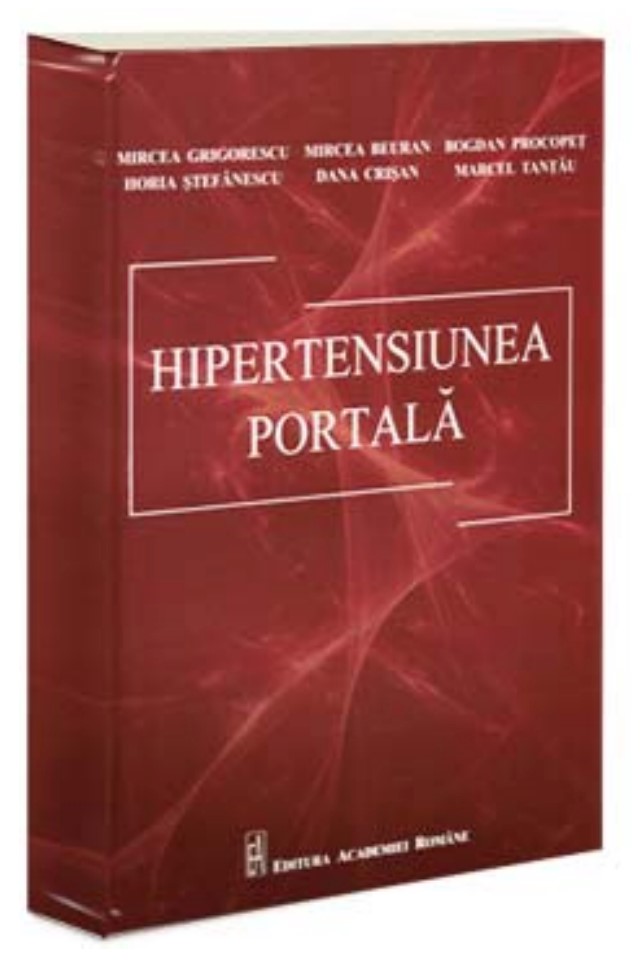 Editors: Mircea Grigorescu, Mircea Beuran, Bogdan Precupeţ, Horia Ștefănescu, Dana Crişan, Marcel Tanţău
National Conferences of the Romanian Society of Surgery have traditionally become opportunities to bring forward remarkable medical textbooks. The 2023 conference provided the academic and social framework for a new such an editorial presentation: Portal Hypertension, coordinated by Mircea Grigorescu, Mircea Beuran, Precupeţ, Horia Ștefănescu, Dana Crişan and Marcel Tanţău, in the Publishing House of the Romanian Academy. The authors belong to a coordinated scientific team, formed by the 3rd Medical Clinic of the "Prof. Dr. Octavian Fodor" Regional Institute of Gastroenterology and Hepatology from Cluj-Napoca and the Surgical Department of the Clinical Emergency Hospital from Bucharest. The above mentioned project is the most recent result of their cooperation.
Portal hypertension is the consequence of the natural evolution of chronic hepatic diseases, which cause a range of morphological and functional disorders, as well as alternations of the extrahepatic blood flow. It represents a complex concept at the crossroads of internal medicine, gastroenterology and general surgery; its theoretical approach therefore naturally involves multi-disciplinary teams. The present work continues older studies by well-known authors, such as the article "Splenectomy in portal hypertension. Immediate and late complications", by D. Burlui et al (1951); the monographies "How do we treat portal hypertension", by D. Burlui (1967) and â??Portal hypertension produced by presinusoidal obstaclesâ?, by D. Setlacec (1987).
The most significant chapters are: Introduction (Anatomy of the portal system; Definition and classification of portal hypertension); Cirrhotic Portal Hypertension (Diagnosis: invasive and non-invasive techniques; Therapeutical principles; Complications and their treatment); Non- Cirrhotic Portal Hypertension (Diagnostic methods; Clinical forms) and Particular Conditions (Pregnancy and portal hypertension; Portal hypertension in children; Nutritional particularities in portal hypertension). As expected, Cirrhotic Portal Hypertension is the most significant part of this work. Modern diagnostic techniques, such as hepatic and splenic elastography, endoscopy and ecoendoscopy, as well as endoscopic video assessment are widely analyzed and their respective advantages and limitations are critically compared. The chapter dedicated to Principles of treatment includes pharmacologic, endoscopic and surgical methods and their specific indications. The main part of this chapter, Complications and their treatment could represent a textbook itself, as general, hepatic, renal, and cardio-pulmonary disorders secondary to the portal hypertension syndrome are detailed over more than 230 pages. Meanwhile, Non-Cirrhotic Portal Hypertension is based on the clinical and etiological classification of the condition which encompasses 9 forms, including: vascular porto-sinusoidal disease, extrahepatic obstructon of the portal vein, sinusoidal obstruction, congenital hepatic fibrosis or Budd-Chiari syndrome.
The value of this work for young as well as for experienced specialists is significant because the most important concepts, such as definition, classification, diagnostic assessment, critical complications - which determine morbidity and mortality rates - and standardized therapeutic options are based on the conclusions of consensus conferences. Additionally, the outstanding clinical and surgical experience of the authors allows them to critically evaluate these data, in accordance to their practical knowledge.
In the modern era, the concept of portal hypertension is correlated to the invasive measurement of the HVPG (hepatic venous pressure gradient). A venous catheter needs to be placed inside the hepatic vein, starting from the internal jugular or the femural vein. First, the WHVP (wedge hepatic venous pressure) is measured, and its value is correlated to that in the portal vein. Then, with the baloon of the catheter not inflated, the FHVP (free hepatic venous pressure) is measured. The difference between these values represents the hepatic venous pressure gradient, i.e. the resistence that the blood flowing from the portal vein needs to overcome. A value smaller than 5 mm Hg is considered to be normal, values between 5 and 10 define subclinical portal hypertension, while 10 or more are the values characteristic of severe stages of the disease. This is only an example of the method used to explain complicated mechanisms and notions, making them easy to read and understand.
The extensive, complete and up-to-date scientific content, the inspired graphical presentation and high-quality pictures used to properly illustrate the text are additional reasons to consider Portal Hypertension a significant editorial event which we highly recommend.


